Unmanned Ground Vehicle Node [UGV-NODE]
UGV Node
A self-driving stack.
RTK-grade positioning, dual redundant IMUs, a 5G uplink and vision models running on the vehicle — the autonomy core for rovers, carts and robots.
Pre-order: reserve today, balance due before dispatch.
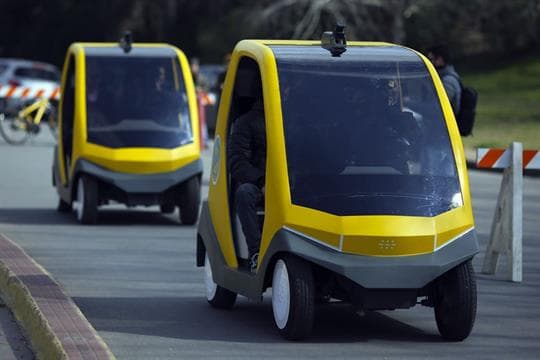
Core
NODE IO FULL · 5 × 5 × 5 cm · 5 boards
Edge AI
48 TOPS · Qualcomm QCM8550
Radio
SDR 100 kHz – 3.8 GHz · 2 × 2 MIMO
Links
5G · LoRa · S-band satellite · Wi-Fi 6
Build qualities
01
CubeSat-standard core
The same 5 cm cube as every NODE IO: five boards on one fabric, built to the CubeSat standard.
02
Kit for the domain
Mounting, enclosure, power and connectors made for the vehicle — the core inside stays identical.
03
Compute at the edge
48 TOPS on board, so the vehicle keeps perceiving and deciding when every link is down.
04
One software across the fleet
SOS runs on every node: air, land, surface and undersea vehicles join the same quantum-secured cluster.
In the box
NODE IO FULL + land kit
- Chassis mounting with shock isolation
- Rugged enclosure for the 5 cm core
- Power input from the vehicle's battery
- CAN, SPI and I²C harness for motors and sensors
The core
Every board, every spec
Full specs of the NODE IO FULL5 boards
- Module
- ESP32-C6-WROOM-1 · 32-bit RISC-V 160 MHz + 20 MHz LP
- Memory
- 320 KB ROM · 512 KB SRAM · 16 MB SPI flash
- GNSS
- SE868K5-RTK multi-band — GPS L1+L5, Galileo E1+E5a, GLONASS, BeiDou, QZSS, SBAS, IRNSS
- Motion
- 2 × BNO055 9-DOF absolute orientation
- Wireless
- Wi-Fi 6 · BLE 5.3 + mesh · 802.15.4 Zigbee, Thread, Matter
- Security
- Cryptographic accelerator · TRNG · RTC
- Battery
- Li-Ion 3.6 V pack on a dedicated connector
- Solar
- Terrestrial 12 V Si mono/poly · space 4–6–8 V GaAsInP — both MPPT
- Rails
- 3 × independent 5 V (2 switchable) · switchable 3.3 V
- Supervision
- PMB / PMA control and alarm bus · per-board power scheduling
- Logging
- RTC-timestamped event log
- Watchdog
- Resets main or compute board on timeout
- Transceiver
- Semtech LR1120 · LoRa® / (G)FSK half-duplex
- Sub-GHz
- 150–960 MHz · +22 dBm HP / +15 dBm HE
- ISM
- 2.4 GHz · +13 dBm, 50 Ω matched
- S-band
- 1.9–2.1 GHz licensed satellite
- Synthesizer
- 150–2600 MHz continuous
- Scanning
- GPS / BeiDou and passive Wi-Fi, on-chip
- SoC
- Qualcomm Dragonwing QCM8550 · 4 nm
- CPU
- 8-core Kryo — 1 × 3.36 GHz + 4 × 2.8 GHz + 3 × 2.0 GHz
- NPU
- Hexagon Tensor Processor · 48 TOPS INT8 · 12 TOPS FP16
- GPU
- Adreno 740 · ray tracing · Vulkan 1.2 · OpenCL 3.0
- Memory
- Up to 16 GB LPDDR5x @ 4200 MHz
- Storage
- UFS 4.0
- Camera
- Triple 18-bit ISP · up to 3 × 36 MP or 1 × 10⁸ MP @ 30 fps
- Connectivity
- 5G sub-6 GHz + mmWave (Rel. 16) · Wi-Fi 7 · Bluetooth 5.3
- Expansion
- PCIe Gen 4 ×2 + Gen 3 ×2 · USB 3.1 Gen 2
- Video
- 8K30 / 4K120 encode · 8K60 decode · AV1
- Transceiver
- Lime LMS7002M FPRF + Lattice FPGA front-end
- Coverage
- 100 kHz – 3.8 GHz, reprogrammable on the fly
- RF front-end
- Integrated PA, filters and LNAs
- Antenna
- Wideband nano antenna across the SDR's complete spectrum
- MIMO
- 2 × 2 with on-chip RF calibration · TDD and full-duplex FDD
- Bandwidth
- 30.72 MHz RF (up to 160 MHz analog) · 72 MSPS · 12-bit
- Reference
- ±1 ppm initial · ±4 ppm stable
- Power
- ≈880 mW full 2 × 2 MIMO · 550 mW SISO
Where it works
Security & public safety
- Patrol of sites and perimeters
- Hazardous-area reconnaissance
- Logistics in the field
- Mesh relay between teams
Commercial
- Warehouse and yard logistics
- Agricultural robots
- Mining and construction sites
- Last-mile delivery
A self-driving stack.
Reserve your UGV Node.
Fleets and custom integration
Tell us about your vehicle and mission. We'll come back with a quote and an integration plan.